
Biography of Gordon H. Hay
CCC Man, Company 937, Camp Louella, Camp Twin, Washington
I'm a retired printer. My time in the Civilian Conservation Corps was in 1934-35 for six months. Looking back 64 years ago might seem an insurmountable task, but I do have a good memory (WHAT DAY IS IT?, but conditions in those days was not hard to recall as we were in the midst of unspeakable Depression.
Roosevelt and Cabinet were hard=pressed to come up with anything to get the guys off the street and employed at worthwhile tasks. They came from all walks of life and with such a varied background that it would be difficult to put them all in one category. I came from a family of Country Weekly newspaper people, and was difficult to get in the CCCs because my mother, although not necessarily needy, was to get $22 a month from me, and I was free to use my $8 in any fashion I desired. At camp, script was issued to keep us in Bull Durham cigarette tobacco, "snoose", or Peerless tobacco (chewing) if we had not spent out script gambling.
Enclosed is a feeble map of the Olympic Peninsula, Washington with inscriptions I hope you can make out. Camp Quilcane on Hood Canalwas a road clearing, trail building and maintenance, and building some bridges. There also were coastal camps along the Pacific Ocean, and being such a we place on our continent, needed "puncheon" laid over the soggy ground to keep the walkers out of the mud. They built libraries, lots of trails and bridges, shelters for Forest Service heavy equipment (we cut thousands of shakes out of cedar for their lean-to facility. All down cedar.) Fire protection, standby fire crews, Parks maintenance and building, campgrounds and improvements to others, trail shelters, etc.
Olympic Peninsula Map by Gordon Hay
At Camp Louella (north and west of Sequim Bay State Park) we lived in tents and even the mess hall was in a tent --- Army style. A Forest Service truck took us to the Two Forks of the Dungeness River (a scary ride along a cliff --- and no guard rails.) I was on a fireplace (outdoors) detail to provide cooking space for campers, fishermen and just visitors. The brick mason building the fireplace was the same man who built our family home in 1922-24! River rock was used exclusively and a steel plate covered the fire pit.
We moved shortly after I got to Louella to Camp Twin, 30 miles west of Port Angeles. Our primary goal was the drainage of a small mountain that was so ridiculous that I'll repeat it here:
The old-time theory of military defense was to build forts surrounding vulnerable areas, i.e., Seattle, Victoria, Puget Sound Naval Shipyard and other vital spots. True to military incompetence, the brass did not realize vessels could pass underwater and planes would fly overhead....so what use was a couple more disappearing 14-inch rifles?
The following are incidents which happened during the time I was in the Corps.
Joe was an avid Bible reader, and would read it rather than got to chow with the rest of us. He was aloof and kept to himself. He was totally involved with the reading of the Bible. He worked on a falling crew, and the axes they used were long, tapered and comparatively thin. They were intended to cut springboard holes (for placement of the springboard above the pitch line, and the fallers (2) stood sideways). One day Joe (not his real name) decided he did not have time enough to read his Bible and put his foot no a log and whacked into his foot, cutting nearly to the leg bone. He spent the rest of his Corps career in his bunk until one day the leg took a turn for the worse and he was taken to Madigan Army Hospital at Fort Lewis (near Olympia) where he eventually lost his foot.
"Shit-for-Brains" (xxxxx) was a Forest Service truck driver and a good one --- most of the time. One rainy night (what else in that country?) we were returning from Port Angeles on a stake body truck where we sat on benches along each side. Of all the stupid ways to build a bridge credit must go to the guy who built the curved bridge over the Lyre River. SFB knew the deck of the bridge was slippery, and didn't realize his cattle truck would heel over on a curve. We did - and the truck left a long green stripe all along the railing of the bridge. He lost most of the control over the truck. Another truck (Army, this time) driver was called "Cannonball." He lived up to his moniker.
The only Negro in camp was a Port Angeles native, and one fine fellow. He worked as a butcher and was very skilled at his trade. But he had no use for his boss, a former restaurant owner in a small town. J. was cutting pork chops the day I saw hi in the cut-up department laying out pork chops faster than you could count. But something had irritated J. and as he cut off each pork chop he would utter: "The son-of-a-bitch, the son-of-a-bitch, the son-of-a-bitch." He was about to cut off his bosses' head, and believe he would have done so had anything happened.
J. also had a four-inch reach over any other in camp when he spread his arms out on a door. And 6'4" Dynamite, if crossed. Just don't do it!
Recreation Halls were something that was in the future, so we made up our own. A deck or two of cards and some magazines were available at the canteen, and playing of poker on someone's bunk comprised what may be called recreation. Once in a while, one barracks of 50 men would challenge another barracks of 50 men to a wrestling match. I had the misfortune to take on the company blacksmith and he was still wearing his caulked (corked) boots. I had buck teeth and after a stalemate ensued, we rolled out of each other's grip and he hit my mouth with the heavy boots. No more trombone playing, which I did with the company orchestra when we were invited to a nearby settlement called Joyce, and the dances were held in the gymnasium. Checker boards, occasional chess board and horseshoes about sums it up. This organization was only one-two years old when I was in the CCC.
We didn't have any fancy cook schools and advanced training. We learned on the end of a two-man "bucking" (cutting logs while in a fallen position, as opposed to a falling saw for downing a tree). One of our falling jobs was cutting down snags --- the home for myriads of wild life. Honey combs, bugs of all sorts and home for many creatures. Heaven forbid! even thinking of doing that today. My falling snags career ended suddenly when after smacking into the butt of a tree and a widow-maker came tumbling down. Fortunately, I got out of the way, and the Forest Service discontinued this practice as too dangerous. We always had good discipline at camp or out on the job. The lead man or the foreman was the boss and he soon let you know. On one job, I was running a survey line (chain --- 16 feet long) in a straight line --- and the foreman in charge knew all the tidal bench marks because he had put them in during World War 1 and could locate where we were just by pushing some brush aside. His name was Bill Daily, and he showed us locations where the "Spruce Loggers" of WW 1 had burned scores of saws, axes, cable and other logging equipment.
When in the field at work we were supplied with peanut butter and jelly sandwiches from the galley, plus canned milk, a fruit and plenty of coffee and sugar. A camp breakfast was typical of a logger's breakfast, four or five kinds of meat, mush, pancakes, eggs, on and on... dinner was very good with platters laden with mashed potatoes, plenty of gravy, four of five kinds of veggies and choices of meat. But the most important item of any meal was the ice-cold milk brought to your table of ten persons --- five on each side, and the "server" would be stationed at the head of the table to bring more of anything needed.
We never had an inspection (unless it was done while we were at work). The bureaucrats had not come into power at this time.
We did no military drills at camp as this was a CIVILIAN camp --- not the Army. And we had olive drab pants and shirts. No marching --- we're not the Army, you know.
Yes, I do recall the names of many of the members, and they mostly are long gone. We had burgees to buy and keep, but I didn't ever get one. We had a canteen of sorts, but it wasn't a Mom and Pop grocery or anything anywhere near it. Bull Durham cigarettes 10 or 15¢ pkg. No group photo, let alone a yearbook. Cameras were rare and developing film no cheapie. Who could afford it?
I went back to what was left of CCC Camp 937*, but it was not the same as I left. Why bring back nostalgic memories of something long gone? I kept in touch with a number of the men long after camp, and some of them did real well financially, and none of them regretted the breach the camps filled. We all learned something we never forgot.
By all means reinstate something on the order of the CCCs. It may work wonders with our juvenile delinquents. The CCC would take care of their own --- and quickly, so they never would forget (one of our members was a convicted murderer).
The Corps would have been a handy source for major disasters, would be immediately ready for military callup or helping the National Guard. Good basic training for undecided as to future occupation. Best non-military training available. Excellent (non-school) for future choice in education, and/or trade, professional screening for enrollees. It would teach them to live and associate with others. Graduates (?) will carry message to others. Crusaders, so be it! Parks and forests budgets are all balled up and nowhere to turn to for funds. Maintenance and protection are severely lacking in ALL parks and forests. Put the CCC to work. Train them. Release seasoned Forest Service people for the jobs they are better qualified to do. Big savings all around.... This system has worked before, why can't a similar pattern be used as a base today? Army material --- dishes, clothing, tools, heavy equipment --- all stored in an Army warehouse, doing no good for anybody. Surplus --- use it. Everything rustic, no frills, basic designs.
----- Gordon H. Hay
*Mr. Hay typed 927 here, but wrote 937 on his map. Research suggests 937 was correct and 927 was a typo
Many of the stories contained in the online James F. Justin CCC Museum are now in paperback and kindle ebook format, with more coming, check out
Thirty Dollars A Day, One Day A Month, by John Kenneth Justin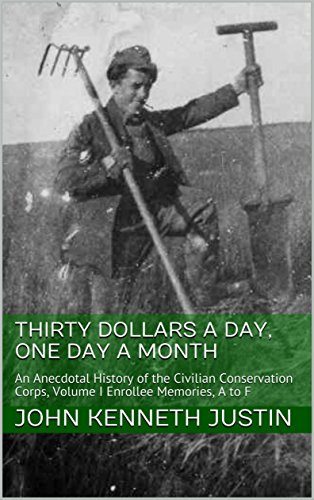
Also, Please help this site preserve our history, become a Patron today. Become a Patron!
LINKS
BACK TO James F. Justin Civilian Conservation Corps Museum Biographies
BACK TO JUSTIN ORAL HISTORY ARMY BIOGRAPHIES HISTORY PAGE
Also Be Sure to Visit
James F. Justin, Civilian Conservation Corps Museum
Justin Museum of Military History
Please Share your Stories! E-mail the Curator to share or discuss or with any questions!
As an Amazon Associate I earn from qualifying purchases.
The URL of this page is below
http://www.justinmuseum.com/oralbio/haygordonhbio.html
Copyright 2021 John Justin, All Rights Reserved